
Part of the Electrochemistry Webinar Series 2026


Conductive AFM and electrochemical (ec)-AFM along with scanning electrochemical probe microscopy (SEPM) such as scanning electrochemical cell microscopy (SECCM) have emerged as powerful in-situ characterization techniques in battery research, correlating morphological and volume changes with interfacial processes, e.g., the electrode-electrolyte interphase (SEI) formation or reorganization of the active battery materials. The webinar will focus on the investigation of the SEI formation on hard carbon (HC) composite negative electrodes for sodium-ion batteries, targeting the influence of the experimental parameters such as the electrolyte composition, cycling conditions etc., on the thickness, nanomechanical properties and chemical composition of the formed SEI using SECCM, conductive-AFM and PinPointTM nanomechanical mapping [1-2].
As an example for positive electrodes, cross-linked poly(3-vinyl-N-methylphenothiazine) (X-PVMPT), a p-type redox polymer [3], promising as an active material in rechargeable aluminium batteries, is investigated using electrochemical ec-AFM. To accommodate the bulky aluminium-based charge carriers from chloroaluminate-based ionic liquid electrolyte, the active material undergoes significant volume changes. To understand the structural and nanomechanical properties underpinning the electrochemical performance, real-time ec-AFM monitoring of the in-situ swelling behaviour provides information on reversible volume changes linked to ion insertion, revealing the dynamic coupling between ion transport and mechanical deformation in the polymer matrix [4].
[2] S. Saleh, S. Daboss, T. Philipp, D. Schaefer, M. Rohnke, C. Kranz ChemElectroChem 12, e202400707, 2025.
[3] G. Studer, A. Schmidt, J. Büttner, M. Schmidt, A. Fischer, I. Krossing, B. Esser, Energy Environ. Sci. 16, 3760, 2023.
[4] S. Daboss, E. Bräutigam B. Esser, T. Cramer, M. B. Durukan; S. Fleischmann, C. Kranz, Electrochim. Acta 574, 149354, 2026.
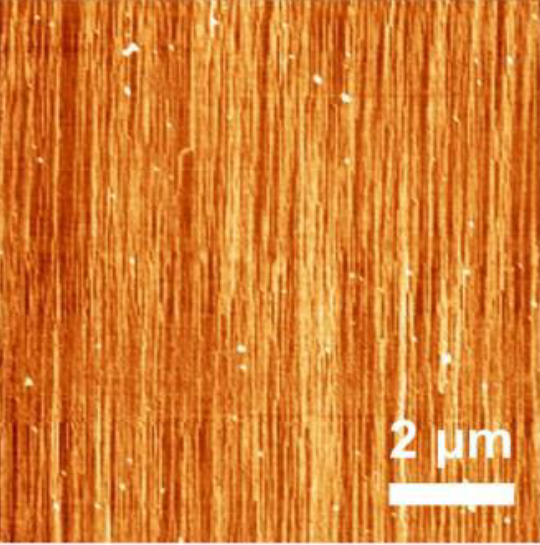
Atomic force microscope image of unidirectionally directionally controlled grown nanofibers
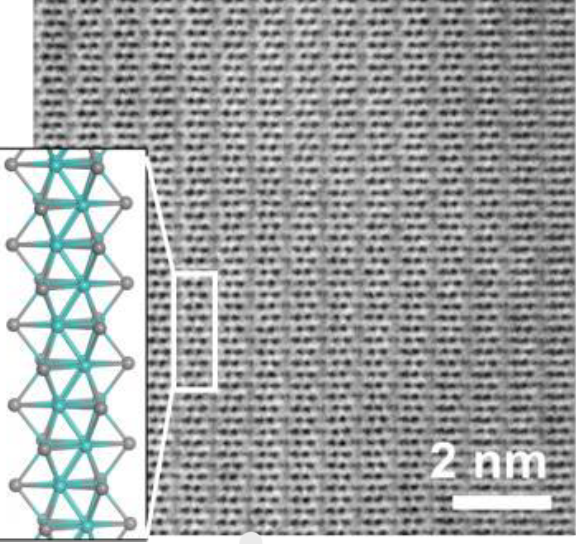
Electron microscope image and structural model of TMC atomic wire nanofibers aggregated in the same direction
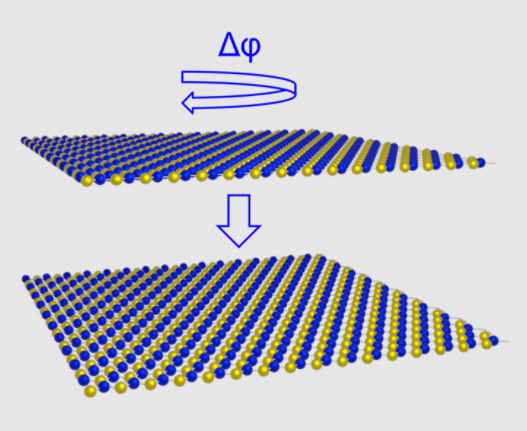
Image caption
Image caption
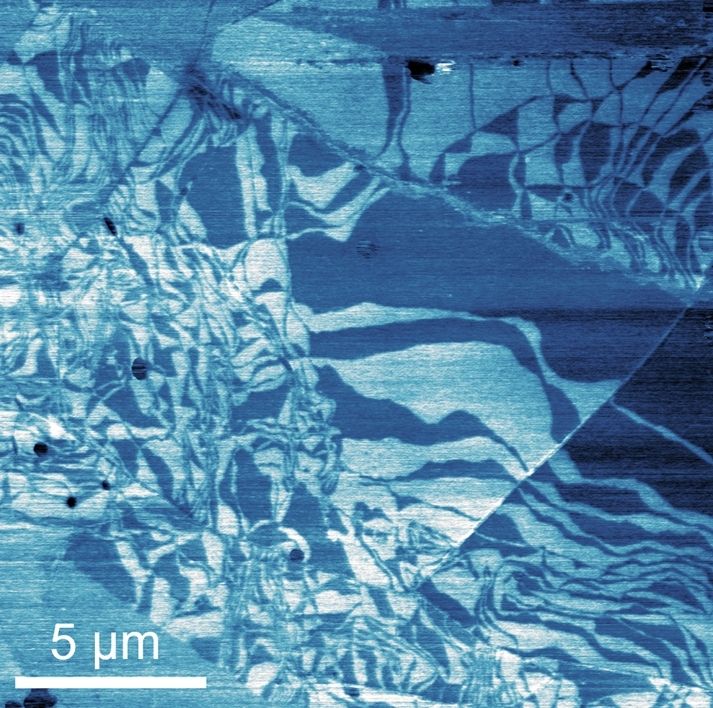
Ferroelectricity is observed in hexagonal boron nitride(hBN) through control of the registry of stacked layers, which we explore through both amplitude-modulated and sideband Kelvin probe force microscopy (KPFM) on the Park FX40 automatic AFM.
A schematic of the formation of parallel stacked bilayer hBN is shown in addition to a contact potential difference map measured using sideband KPFM.
Image caption
Image caption
Image caption


Dr. Christine Kranz received her Ph.D. in Chemistry from the Technical University of Munich (Germany). After spending a year as a postdoctoral fellow at the Vienna University of Technology, Institute of Analytical Chemistry (Austria), she accepted a position at the School of Chemistry and Biochemistry, Georgia Institute of Technology (USA). In 2008, she returned to Germany and is currently Professor at Ulm University, Institute of Analytical and Bioanalytical Chemistry (IABC). Her main research focus is on scanning (electrochemical) probe microscopy for studying interfacial processes at post-Li battery materials and light-driven molecular photocatalysis systems, besides she works on the development of miniaturized electrochemical sensors for bioanalytical applications. She published more than 290 papers in peer-reviewed journals. She is on the editorial boards of ACS Electrochemistry, Electrochemical Science Advances, Analyst, and Electrochimica Acta. Since 2020, she is Editor of Bioelectrochemistry (Elsevier).