



AFM Certification Course
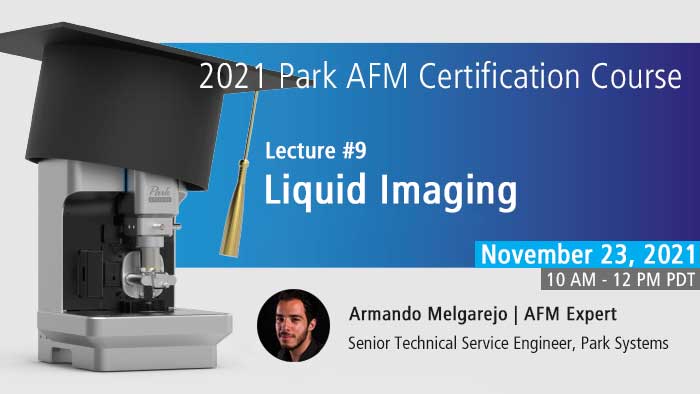
How to do Atomic Force Microscopy in liquid conditions?
An approximately one-hour lecture on how the AFM fundamental operation modes (True Non-ContactTM, Contact, PinPoint, and Tapping) work in liquid conditions. Hardware changes for an NX system will be discussed. Application cases will be discussed as well (e.g., DNA imaging, Hydrogel analysis for protein separation, fibrils imaging). Questions are welcomed at any time during the session. Introductory Liquid imaging Video (10 min)
Interactive Demo Session Nine:
Lecture topics will be reinforced through demonstration and practice of True Non-Contact™, Tapping, and PinPoint™ in liquid conditions on a Park Systems NX series AFM. Emphasis will be put on the differences between air and liquid imaging and how this affects the acquisition of topography information. Collagen fibrils will be used as a demonstration sample. Questions are welcomed at any time during the session.
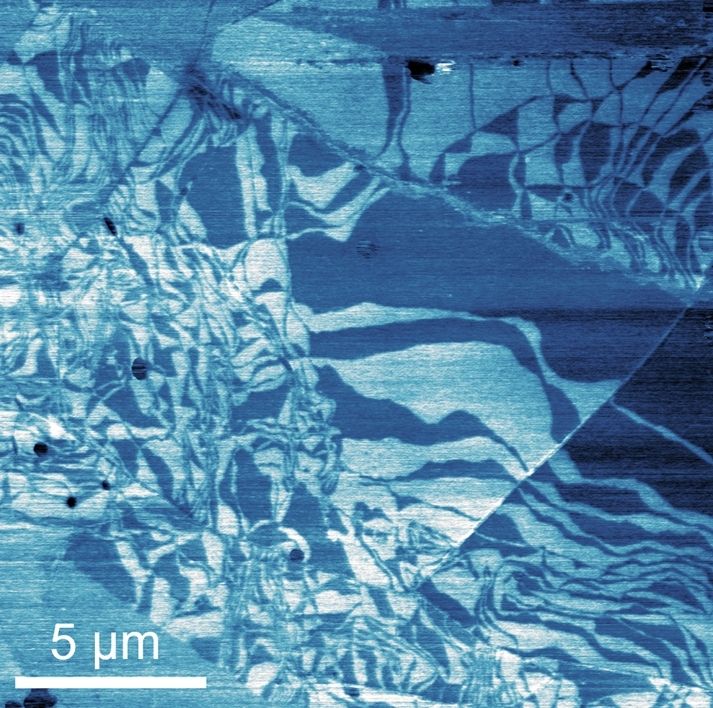
Ferroelectricity is observed in hexagonal boron nitride(hBN) through control of the registry of stacked layers, which we explore through both amplitude-modulated and sideband Kelvin probe force microscopy (KPFM) on the Park FX40 automatic AFM.
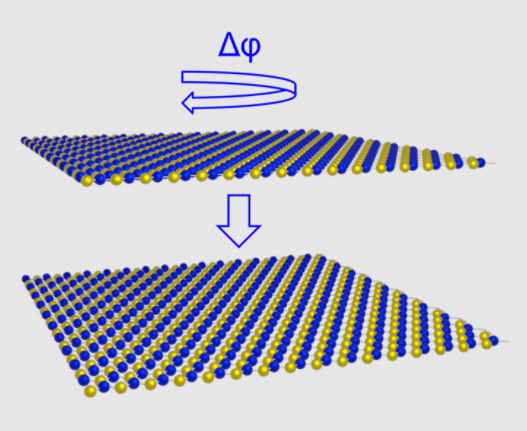
A schematic of the formation of parallel stacked bilayer hBN is shown in addition to a contact potential difference map measured using sideband KPFM.
Image caption
Image caption
Image caption

Armando Melgarejo is an engineer for Park Systems, where he focuses on the installation and support of AFM systems for Park’s research user base. He holds a B.S. in Biotechnology Engineering from Autonomous University of Queretaro, Mexico. During his studies, he also spent a semester doing research in nanotechnology and molecular biology at Czech Technical University in Prague, Czech Republic. Other areas of expertise include diverse characterization techniques (AFM, SEM, RAMAN and IR), genetics and molecular and cell biology.