
DHM Webinar Series | 2026
Dynamic processes in biological and material systems often occur in three dimensions, making conventional 2D imaging and mechanical Z-scanning insufficient for capturing rapid motion and volumetric information. Digital Holographic Microscopy (DHM) enables fast, label-free, and quantitative 3D volumetric imaging and 4D time-resolved tracking by recording the optical wavefront in a single hologram and digitally reconstructing three-dimensional information without mechanical Z-scanning. This approach provides high-speed volumetric measurements with nanometer-scale axial sensitivity, allowing dynamic processes to be captured and analyzed across both space and time.
DHM-based 3D volumetric imaging and 4D time-resolved tracking support a wide range of applications, including 3D tracking of swimming cells and microorganisms, flagellar motion analysis, particle tracking for flow characterization, and depth-resolved inspection of transparent materials. With axial localization precision down to tens of nanometers and high temporal resolution, DHM enables quantitative analysis of fast and complex three-dimensional dynamics. By extending conventional microscopy beyond static 2D observation, DHM provides a versatile, non-contact imaging platform for life sciences, fluid dynamics, and advanced materials characterization.
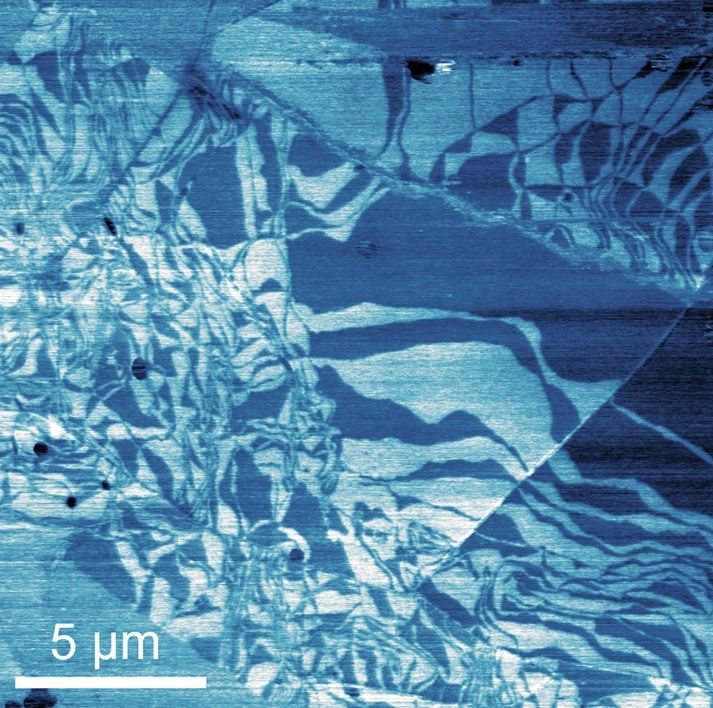
Ferroelectricity is observed in hexagonal boron nitride(hBN) through control of the registry of stacked layers, which we explore through both amplitude-modulated and sideband Kelvin probe force microscopy (KPFM) on the Park FX40 automatic AFM.
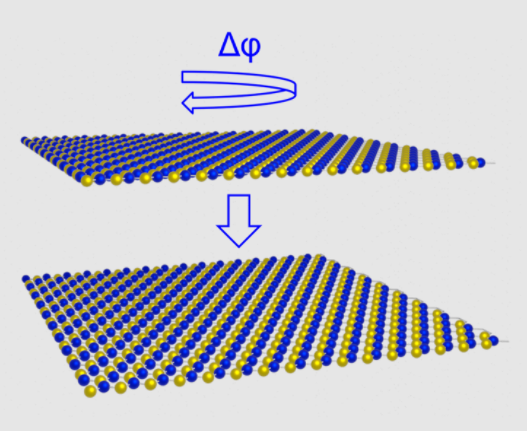
A schematic of the formation of parallel stacked bilayer hBN is shown in addition to a contact potential difference map measured using sideband KPFM.
Image caption
Image caption
Image caption
Ferroelectricity is observed in hexagonal boron nitride(hBN) through control of the registry of stacked layers, which we explore through both amplitude-modulated and sideband Kelvin probe force microscopy (KPFM) on the Park FX40 automatic AFM.
A schematic of the formation of parallel stacked bilayer hBN is shown in addition to a contact potential difference map measured using sideband KPFM.
Image caption
Image caption
Image caption


Chris Jung is a DHM Engineer in the Optical Equipment Division at Park Systems Corporation. He holds a bachelor's degree in Physics with a focus on optics, and completed his graduate research centered on 2D materials.
Before transitioning to optical instrumentation, Chris spent approximately six years as an AFM engineer, building deep expertise in surface metrology and customer-facing technical support. When Park Systems launched its optical equipment division, he joined the team as its dedicated DHM specialist.
With extensive experience across webinars, roadshows, conferences, exhibitions, and customer demonstrations, Chris brings a uniquely broad perspective to applications support, helping customers find practical solutions to their most challenging measurement problems.