
Part of the FX200 Webinar Series: Exploring layered materials with automated Atomic Force Microscopy

AFM is a go-to technique for measurements of the nanoscale surface morphology and functional properties of layered materials due to its excellent spatial resolution and surface specificity. One aspect of AFM that has increasingly been exploited of late in layered materials research is using the probe to post-process and manipulate samples deterministically. Examples of where manipulation has been done include anodic oxidation to cut flakes of layered materials, applied bias to pole ferroelectric layers, the application of force to control the orientation between and strain across flakes, removal of trapped interfacial contamination and the formation of single photon emitters by indentation.
In this webinar, we will showcase the ability of our FX series AFMs to manipulate layered samples and facilitate systematic experiments based on twist angle, layer sliding and strain in layered materials. Our FX series AFMs have unique features that are ideal for this task, namely excellent resolution and the ability to switch probes and modes automatically, with no need to touch the instrument. We will give a live two-part demonstration where we first show the cutting of graphene flakes by anodic oxidation and use our probe switching functionality to switch to a new probe to generate high resolution images of the results of cutting. We will then demonstrate the ability of our systems to seamlessly switch modes to measure moiré patterns in a marginally twisted MoS2 bilayer via lateral force microscopy and conductive AFM, prepared using high temperature AFM cleaning.
We will demonstrate that the combination of excellent performance across the full range of AFM modes with advanced automation enables the formation and characterisation of layered materials heterostructures with controlled twist angle, improved cleanliness and lateral patterning. Our FX series AFMs make it much easier for researchers in the layered materials field to prepare samples and verify what they have made, enabling much more sophisticated experiments than traditional AFMs!
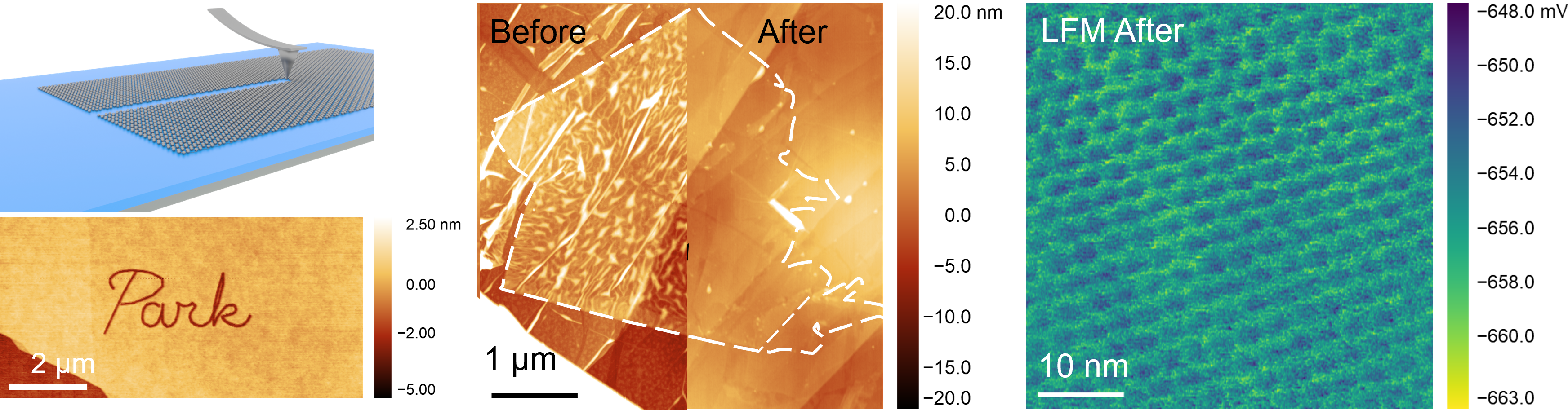
Fig.1. A look at some ways of manipulating and postprocessing samples. On the left, a schematic showing local anodic oxidation of graphene is displayed in addition to the result of a user defined cut (left). In the centre panel we show a comparison before vs after cleaning a twisted MoS2 bilayer using contact mode at high temperature, with a lateral force microscopy (LFM) image shoring a moiré pattern formed at the clean interface shown on the right.
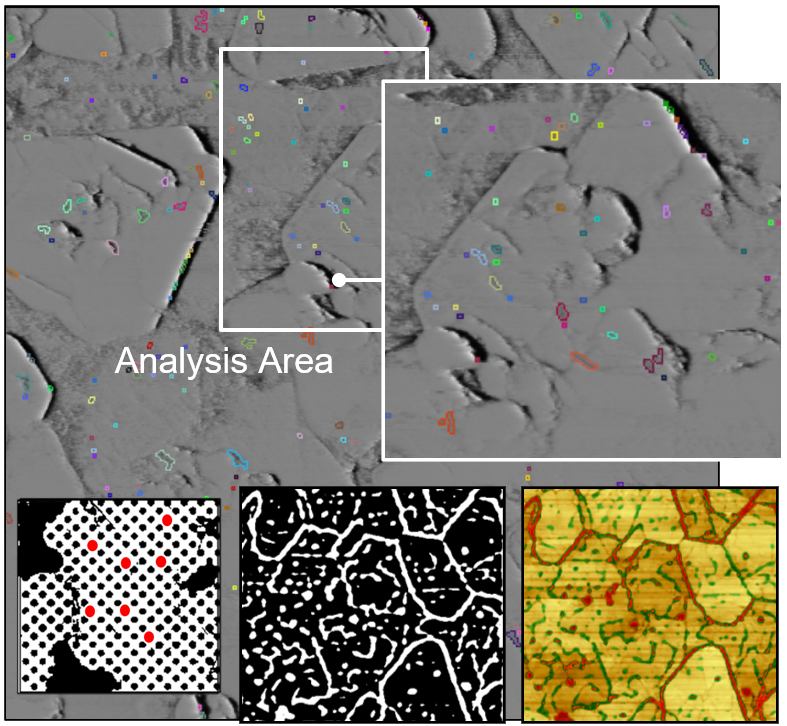
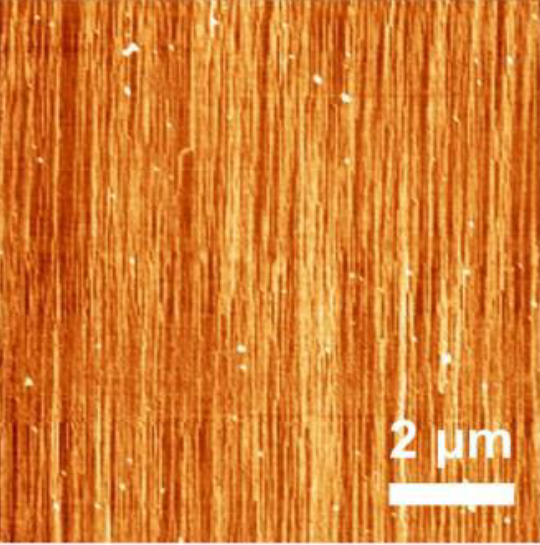
Atomic force microscope image of unidirectionally directionally controlled grown nanofibers
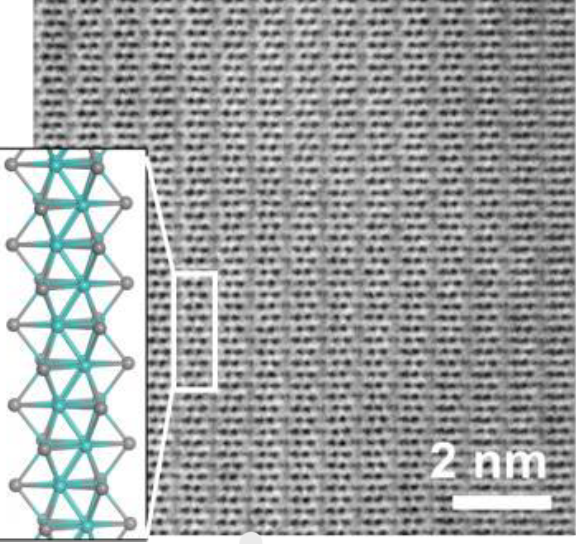
Electron microscope image and structural model of TMC atomic wire nanofibers aggregated in the same direction
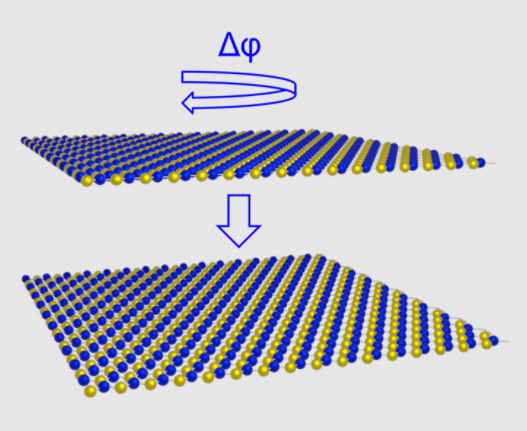
Image caption
Image caption
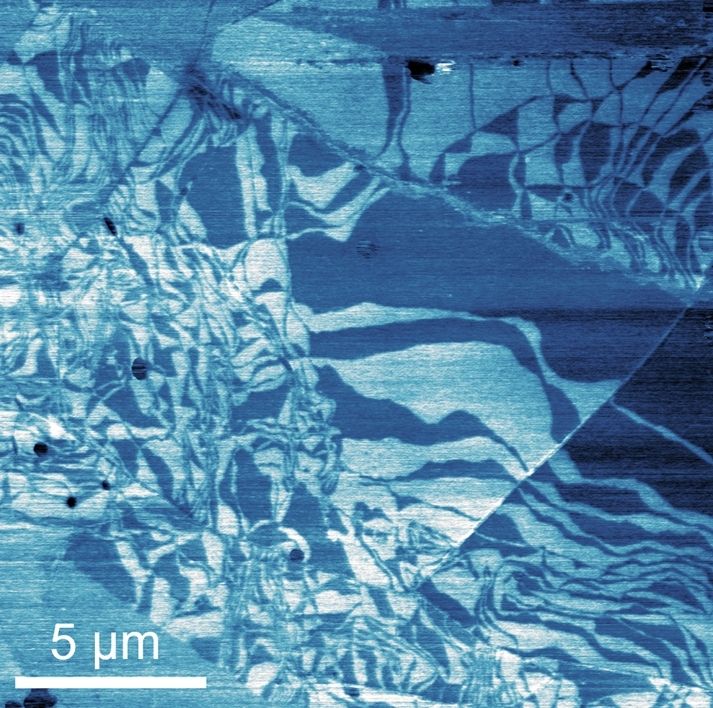
Ferroelectricity is observed in hexagonal boron nitride(hBN) through control of the registry of stacked layers, which we explore through both amplitude-modulated and sideband Kelvin probe force microscopy (KPFM) on the Park FX40 automatic AFM.
A schematic of the formation of parallel stacked bilayer hBN is shown in addition to a contact potential difference map measured using sideband KPFM.
Image caption
Image caption
Image caption

James received his PhD in Physics from the University of Nottingham in 2018, studying the morphology and optical properties of monolayers of self-assembled molecules and their heterostructures. He then went on to work as a postdoctoral researcher, also at the University of Nottingham, working on the formation of hybrid heterostructures of molecular assemblies and layered materials demonstrating both electroluminescence and selective triplet excitation. In 2020, James took up a position as a postdoctoral researcher at the Cambridge Graphene Centre, using scanning probe microscopy and optical spectroscopy to study electrostatics and optical properties of layered materials heterostructures with controlled twist angle and their scalable incorporation into integrated photonic circuits. From January 2022 to 2024, James was a member of the Park Systems team working as an applications scientist, supporting customers with interest ranging from fundamental physics to industrial scale production in the application of a diverse range of scanning probe microscopy techniques. Following an 18-month postdoctoral position working on tip-enhanced Raman spectroscopy at the University of Nottingham, James rejoined Park Systems in August 2025 working as a technical marketing and applications scientist, showcasing and supporting the implementation of state-of-the-art automated AFM.